
Pool Fence Rules in Bucks County: What Your Inspector Will Check
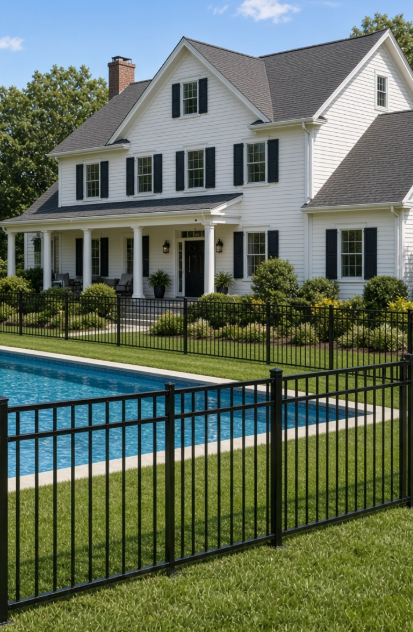
If you’re putting in a pool this year, or finally replacing the tired fence around the one you have, the fence isn’t just a design choice. In Pennsylvania, a pool barrier has to meet the state’s Uniform Construction Code (the UCC), which pulls in the International Swimming Pool and Spa Code. Your township’s code official inspects against those rules, and a fence that misses by an inch can hold up your final approval.
Here’s what we check on every pool fence job in Bucks and eastern Montgomery County, in plain language. Your township has the final word, so treat this as a homeowner’s checklist rather than the code itself.
Height: 48 inches, measured from the outside
The top of the barrier has to be at least 48 inches above grade, measured on the side away from the pool. That height has to hold all the way around, and for 3 feet out from the fence. This is where sloped yards trip people up. If the ground rises on the outside of the fence, a 4-foot panel can end up measuring less than 48 inches where it counts. On hilly lots we step or rack the panels and check height at the high spots, not just at the posts.
Gaps at the bottom
The space between the ground and the bottom of the fence can’t be more than 2 inches over grass, mulch, or gravel, or 4 inches over a solid surface like concrete or pavers. Kids will crawl under anything they can. If your yard has dips, plan for some grading or a fence style that can follow the ground.
No openings a 4-inch ball can pass through
Anywhere in the barrier, an opening shouldn’t let a 4-inch sphere through. That rules out a lot of decorative styles and wide-spaced pickets around a pool, even if they’d be perfectly fine on the rest of the property.
Horizontal rails can turn a fence into a ladder
This is the rule most people have never heard of. If the horizontal rails on your fence are less than 45 inches apart (top to top), the code treats them as climbable. In that case the rails have to face the pool side, and the gaps between the vertical pickets can’t be more than 1¾ inches. If the rails are 45 inches or more apart, picket spacing can go up to 4 inches.
In practice, that’s why aluminum pool fence is usually built with tighter picket spacing than standard ornamental fence, and why the “nice side” on a pool fence often faces out.
Chain link and lattice
Chain link can work as a pool barrier, but the mesh openings can’t be larger than 1¾ inches, which is smaller than typical residential chain link. Slats can be used to bring the openings down if they’re fastened at the top and bottom. Diagonal or lattice-style fences follow the same 1¾-inch limit.
Gates are where most inspections fail
A pool gate has more rules than the rest of the fence combined:
- Walk-through gates must swing outward, away from the pool.
- They have to be self-closing and self-latching. Push it open, let go, and it should swing shut and latch on its own every time.
- The gate has to be able to take a lock.
- The latch release needs to be at least 54 inches off the ground. If it’s lower than that, it has to be on the pool side, at least 3 inches below the top of the gate, with no openings bigger than ½ inch within 18 inches of the latch, so a child can’t reach through.
- On double gates, one leaf has to be secured in place and the other has to self-latch.
Gate hardware also needs adjusting over time. Posts settle, hinges loosen, and a gate that latched perfectly in June might stop catching by next spring. Test it at the start of every swim season.
Keep climbing aids away from the fence
Pool equipment, AC units, planters, storage boxes, and trees can all give a kid a boost. The guidance calls for a clear zone of at least 36 inches on the outside of the barrier. When we lay out a pool fence, we look at where the pump and filter sit before we set a single post.
When the house is part of the barrier
If a wall of your house forms one side of the pool enclosure and there’s a door or low window that opens toward the pool, the code requires extra protection, such as an alarm on those doors and windows or a listed safety cover on the pool. That’s a conversation to have with your pool installer and your code official early, before the fence layout is final.
Permits, HOAs, and utility marking
Most townships in our area require a permit for a new fence, and pool barriers get extra attention. Newtown Township, for example, asks for a letter from your HOA with the permit application if you live in an HOA community. Front-yard height limits and setbacks also vary from township to township, so a pool near the street or on a corner lot needs a closer look.
Before any digging, Pennsylvania requires a call to PA One Call (811) to mark underground utilities. Around a pool, that matters even more, since there may be electrical and plumbing lines that aren’t on any public map.
We handle the permit paperwork, HOA approvals, and the 811 call as part of the job, so you’re not chasing forms while the pool crew waits.
Picking the right material
Aluminum is the most common pool fence we install because it’s built to meet barrier spacing, doesn’t rust, and doesn’t block the view of the pool. Vinyl works well if you want privacy around the pool, as long as the design doesn’t create footholds. Wood can meet code too, but it needs regular upkeep to keep gates hanging and latching the way they should.
Get it right the first time
A pool fence that fails inspection means rework, a second inspection, and often a pool you can’t use yet. If you’re planning a pool or want a second look at the fence around one you already have, request a free on-site estimate. We’ll walk the yard, check grade and gate locations, and give you a layout that’s built to pass.