You planted tomatoes, and the deer got them. You planted arborvitae along the property line, and by February the bottoms were stripped bare. You put in a few fruit trees, and the young branches got nibbled down to sticks. Deer pressure is heavy across Bucks County, from the farms around Quakertown and Buckingham to wooded lots in Washington Crossing. 76 FENCE BucksMont installs deer and garden fencing that actually keeps them out.
Height is the whole game
Deer are strong jumpers. A fence that works for a dog won’t stop a determined deer. To be effective, deer fencing generally needs to be tall, often 7 to 8 feet. Anything shorter tends to become an obstacle deer learn to clear. Before we build, we’ll check your municipality’s rules, since fence height limits vary and a tall fence may need a permit. Our fence permits page covers that.
Make it visible
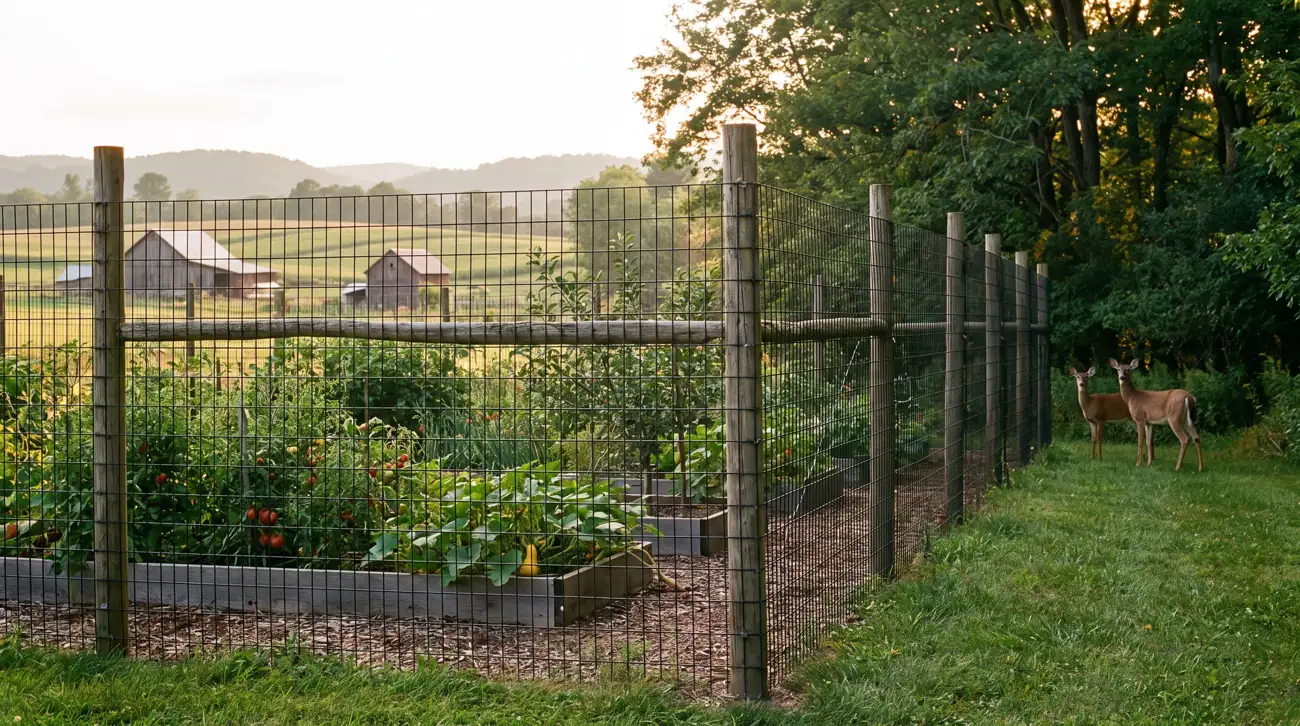
Deer don’t always see thin mesh, especially at dusk, and a deer that runs into a fence may damage it. Common fixes include using a black mesh or metal fence that shows up against the background and adding a visible top rail or flagging when a new fence goes in. Once deer learn the fence is there, they usually go around it.
Black fencing also tends to fade into the landscape from a distance, so it protects your garden without making the yard look like a compound.
What are you protecting?
Vegetable gardens
Fencing just the garden beds is often the most practical option. It keeps the enclosure manageable and the rest of the yard open.
Orchards
Fruit trees are a deer favorite. An enclosure around the orchard keeps buds, fruit and branches safe.
Young trees and shrubs
New plantings are most at risk. Fencing the planting area protects them until they’re established.
Whole yard
On some properties, fencing the entire perimeter makes more sense. It’s a bigger project, and gates and driveways need planning.
Gates matter as much as the fence
A deer fence is only as good as its weakest spot, and that’s usually the gate. Gates should be as tall as the fence, close snugly, and be wide enough for what you use: a wheelbarrow, a garden cart or a small tractor. A gate that gets left open once is an invitation. Self-closing hardware can help on a garden gate you pass through constantly. See our gates page for options.
Ground and terrain
Deer fence runs often cross uneven ground, tree roots and old stone walls, especially on older lots. Rocky soil in central and upper Bucks County can make post setting slower, and clay near creeks can stay soft. Tall fences catch more wind, so posts need to be set solidly. We’ll plan post spacing and footing for your ground. If your garden sits on a hillside, our guide to fencing a sloped yard explains how fences follow a slope.
Material choices
Deer fencing can be built several ways, and the right one depends on the look you want and how long you want it to last. Options include black mesh on wood or metal posts, welded wire, and taller black vinyl-coated chain link. For a more decorative look near the house, ornamental steel can work, though height limits and budget will factor in. We’ll lay out the trade-offs during your free estimate. If you have livestock too, see horse and farm fence.
Our process
- Walk the area. We look at where the deer come from, the ground, and what you need to protect.
- Plan the layout. Enclosure size, gate locations and material.
- Permits and 811. We handle municipal permits and the PA One Call request.
- Install. Posts set solid, fence tight, gates that close.
Get a deer fence estimate
Estimates are free, with no dispatch fee. Call 215-602-4334 for central and upper Bucks County, or 610-477-7080 for lower Bucks and eastern Montgomery County.
Get a straight answer on your fence.
Free on-site estimate, zero dispatch fees. We handle the permit, the HOA paperwork and the 811 call.