Board-on-Board vs. Shadowbox vs. Stockade Fences in Bucks County: Which Style Fits Your Yard?
If you’ve decided on a wood privacy fence, the next question is which style. Most of the privacy fences we build around Bucks and eastern Montgomery County come down to three choices: stockade, board-on-board, and shadowbox. They can look alike in a catalog photo, but they’re built differently, and those differences show up in privacy, wind, how the fence looks from your neighbor’s side, how much lumber goes into it, and how much care it needs. This guide breaks down board on board vs shadowbox fence styles, plus classic stockade, so you can pick the one that fits your yard.
One heads-up before we start: these names get used loosely. One company’s “board-on-board” is another company’s “shadowbox.” Whoever you hire, ask for a drawing or a sample section so you know exactly what you’re getting.
How each style is built
- Stockade: A single layer of pickets set edge to edge on one side of the horizontal rails. It’s the classic backyard privacy fence, often with pointed or dog-eared tops. The pickets face out, and the posts and rails show on the inside.
- Board-on-board: Two layers of pickets that overlap. The first layer goes up with gaps between boards, and the second layer covers those gaps, overlapping the boards on either side. Depending on the build, both layers sit on the same side of the rails or one layer goes on each side.
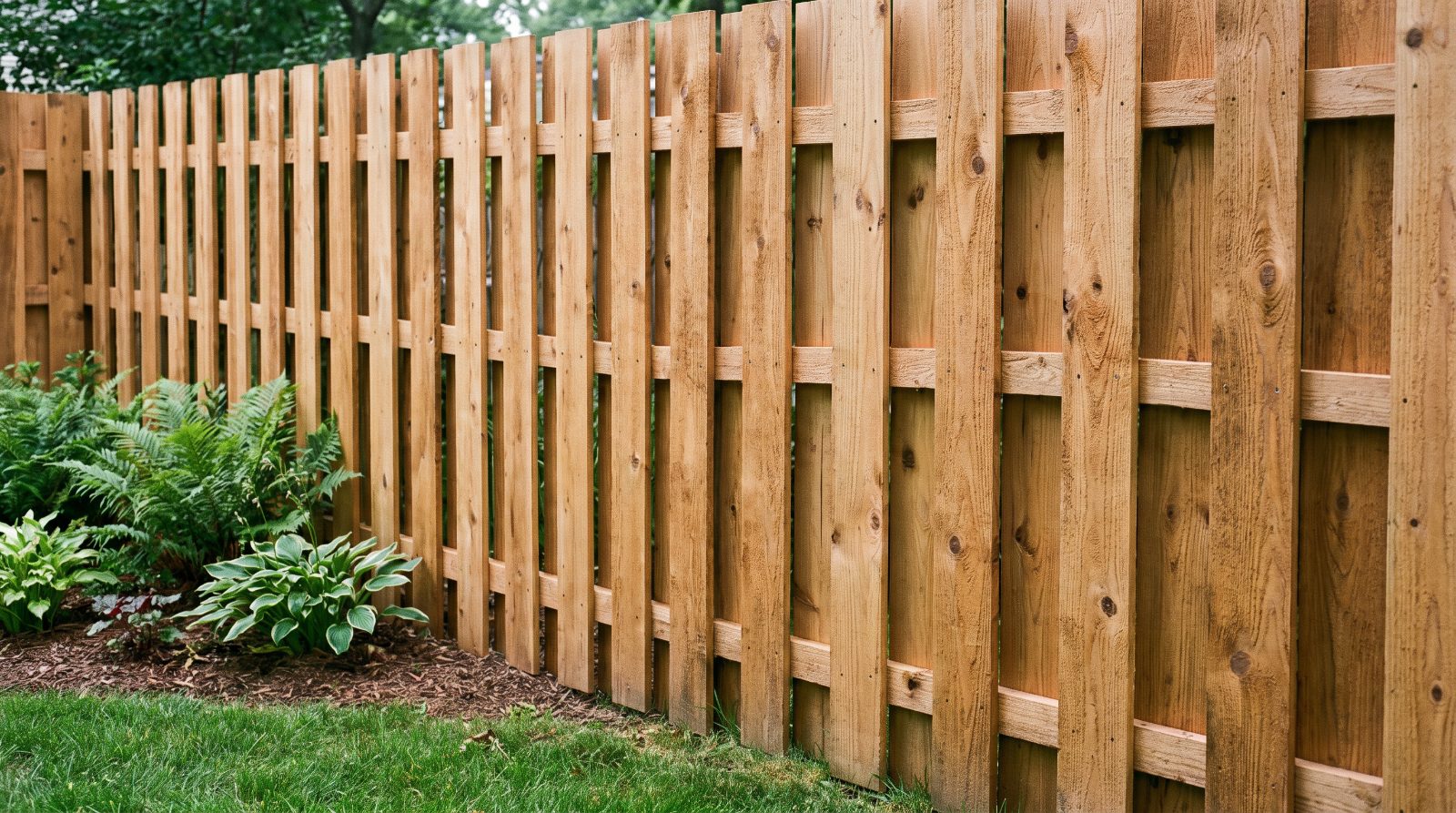
- Shadowbox: Pickets alternate from one side of the rails to the other, with the boards on each side spaced so they cover each other’s gaps. Looking straight at it, you see a solid wall. Looking at an angle, you can see between the boards, and air moves through.
Board on board vs shadowbox fence: privacy and see-through
If complete privacy is the goal, board-on-board is the strongest choice of the three. Because the boards overlap, there’s no line of sight through the fence from any angle, and that holds even as the wood dries and shrinks over its first seasons.
Stockade starts out tight, but it’s a single layer of boards butted together. Wood moves with the seasons here, swelling in humid summers and shrinking in dry winter air, so small gaps can open between pickets over time. For most backyards that’s fine. If you’re screening a hot tub or a patio that sits right against the fence, those slivers of daylight can bug you.
Shadowbox gives you privacy from straight on and partial privacy at an angle. Someone walking along the fence line can catch glimpses through it. For a lot of homeowners that’s a fair trade for what it does well, which is airflow and a good look from both sides.
Wind: solid fences take the full push
A solid fence acts like a sail. Stockade and board-on-board both block wind completely, so every gust pushes on the whole face of the fence and loads the posts. That’s manageable with proper post depth, concrete or well-compacted footings, and good spacing, but it matters more on open, exposed lots. Think hilltop properties, former farmland in the northern part of our territory around Quakertown and Perkasie, and new developments where the trees haven’t grown in yet.
Shadowbox lets air pass between the boards, which takes some of that load off the posts. On a windy lot where you still want a lot of privacy, it’s often the smarter pick. We cover wind and post setting in more detail in our post on vinyl privacy fences in high winds, and the same principles apply to solid wood fences. Posts that aren’t set deep enough can also shift with freeze and thaw, which we explain in our guide to leaning fence posts and frost heave.
The view from both sides: being a good neighbor
Stockade has a “good side” and a “back side.” The usual practice, and the courteous one, is to face the finished side out toward the neighbor or the street, which means you look at the posts and rails from your own yard. Some HOAs and neighborhoods expect it that way, so check before you build.
Shadowbox looks essentially the same from both sides, which is why it’s so popular on shared property lines. Nobody gets stuck with the back of the fence. Board-on-board can also be built to look finished on both sides when the layers go on opposite sides of the rails, but if both layers sit on the same side, one side shows the framing. If keeping the peace with the folks next door matters to you, our good-neighbor fence tips are worth a read.
Material use
Stockade uses the least lumber of the three, since it’s a single row of pickets. Board-on-board and shadowbox both need extra boards to cover the gaps, so they use noticeably more wood per foot of fence, and the added weight is one more reason post setting matters. How much more depends on how much the boards overlap, which is something to settle with your installer up front. More overlap means better privacy, more material, and a heavier fence.
The wood itself matters as much as the style. Cedar and pressure-treated pine behave differently as they weather, shrink, and age. Our comparison of cedar vs. pressure-treated wood fences in Bucks County goes through the trade-offs, and you can see the styles we install on our wood fences page.
Maintenance
- Stockade: The simplest to stain or seal. You’re mainly covering one face of pickets, plus the posts and rails on the back.
- Board-on-board: The overlapping boards create tight spots where water and debris can sit, and where a brush or sprayer has trouble reaching. Sealing the boards before or right after installation, once the wood is ready, helps a lot. Keep soil, mulch, and leaves pulled back from the bottom.
- Shadowbox: More surface to cover, since both sides are “show” sides and the boards are spread across both faces of the rails. On the plus side, the open spacing lets the wood dry out faster after rain.
Whatever style you pick, a regular staining or sealing schedule is what keeps wood looking good and lasting. Our guide to staining and sealing a wood fence in Bucks County covers timing, products, and prep.
Which style fits your yard?
- Choose board-on-board if you want total privacy, especially around a pool deck, hot tub, or patio, or if a neighbor’s windows look straight into your yard. It’s also a good fit for a sheltered lot where wind isn’t a big concern.
- Choose shadowbox if the fence sits on a shared line and you want it to look good from both sides, or if your lot is open and windy. It’s a solid compromise between privacy, airflow, and curb appeal.
- Choose stockade for long runs where you want privacy with the least material, such as a back property line along woods or a field, or anywhere a traditional look suits the house.
Prefer low maintenance over the look of real wood? Vinyl comes in solid privacy panels and in shadowbox-style designs too. See our privacy fence page for wood and vinyl options side by side.
Check height limits before you pick a style
Privacy fences are usually built tall, and height limits vary by township and borough. Many towns allow a taller fence in the side and rear yards than in the front yard, and corner lots often come with extra restrictions near the street. A 6-foot board-on-board fence that’s fine in one town may need to come down a size, or move back, in the next one over. Our fence permits page explains how we handle permits, and we’ve written town-by-town guides for places like Quakertown Borough.
See the styles in person
The easiest way to decide is to stand in your yard with someone who builds these fences every week. We’ll look at your property lines, how exposed the lot is to wind, what you’re trying to screen, and what your neighbors will see, then recommend the style and wood that make sense. Request a free on-site estimate through our contact page, or call our Doylestown office at 215-602-4334 (central and upper Bucks) or our Newtown office at 610-477-7080 (lower Bucks and eastern Montgomery).