Cedar vs. Pressure-Treated Wood Fences in Bucks County: Which Lasts Longer?
You’ve decided on a wood fence. Good—now comes the question we hear on almost every estimate in Bucks County: cedar or pressure-treated pine? Both are real wood, both can look great, and both can last a long time when they’re built right. But they behave differently in our climate—humid summers, wet springs, and winters that freeze and thaw over and over. This guide breaks down cedar vs pressure treated fence lumber the way we look at it in the field: rot and insects, movement, appearance, posts, and when each one makes sense.
How each wood fights rot and insects
The two woods get their protection in completely different ways.
- Cedar resists decay and insects naturally. The protection comes from oils and extractives in the heartwood—the darker, inner part of the log. Sapwood (the lighter outer layer) doesn’t carry the same resistance, so board quality and grade matter. A cedar picket with a lot of pale sapwood won’t hold up like a clear heartwood board.
- Pressure-treated pine starts as a wood with little natural resistance. It gets its protection from preservatives forced into the wood under pressure at the treating plant. That treatment is what lets pine sit outdoors—and, at the right rating, in the ground—without rotting out quickly.
One catch with treated lumber: the preservative doesn’t always reach the very center of the board. When you cut a treated post or rail, the fresh end is less protected than the outside. Good installers keep cuts out of the ground and treat cut ends with an end-cut preservative. Cedar doesn’t have that issue in the same way, but its resistance fades over many years as the extractives leach out.
Freeze-thaw winters and humid summers
Bucks and eastern Montgomery County are tough on wood because it rarely stays dry for long. Rain and snowmelt soak into end grain and small cracks, then freeze, expand, and thaw. In July and August, humidity keeps boards damp, and anything shaded or tight against shrubs dries slowly. That cycle is what opens checks, loosens fasteners, and invites rot at the bottoms of pickets and the tops of posts.
Neither wood is immune. What makes the difference is detail work: pickets held off the soil so they don’t wick moisture, post tops cut or capped to shed water, good airflow along the fence line, and keeping mulch beds and sprinklers from soaking the bottom of the boards. Those habits matter more than the species label.
Warping, shrinking, and checking
This is where the two woods differ the most day to day.
- Pressure-treated pine usually arrives wet from the treating process. As it dries over its first months outdoors, boards shrink, and some will cup, twist, or check (develop surface cracks). Gaps can open between tight-set pickets. That’s normal for treated lumber—not a defect—but it’s worth knowing up front, especially on a solid privacy style.
- Cedar is lighter and more dimensionally stable. It moves less as seasons change, so it tends to stay flatter and straighter, and it’s less likely to pull at its fasteners. It’s also a softer wood, so it dents and scratches more easily.
Fasteners matter with both. Treated lumber’s preservatives are hard on plain steel, so we use hot-dip galvanized or stainless fasteners. Cedar can stain black around ordinary steel nails, so stainless is the safe call there too.
Appearance and how each one weathers
Fresh cedar has warm reddish-to-tan tones and a pleasant smell, and the grain is usually tighter and cleaner looking. Pressure-treated pine often has a green or brown tint from the treatment, with more visible knots and grain variation.
Left alone, both turn gray in the sun. Cedar weathers to a soft silver that a lot of homeowners like, especially on older homes and wooded lots. Treated pine fades to a flatter gray and tends to show checking more as it ages. If you want to keep the original color of either wood, a finish is the way to do it.
Maintenance: plan for it either way
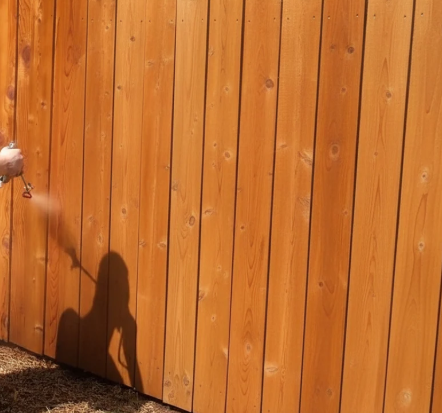
Cedar’s natural resistance doesn’t mean “never touch it,” and pressure treatment doesn’t make a fence waterproof. Both benefit from regular cleaning and a penetrating stain or sealer to slow moisture swings and UV graying. One timing difference: treated pine usually needs to dry out before it will take a finish, while dry cedar can often be finished sooner. For timing, product types, and how we approach it in our climate, see our guide to staining and sealing a wood fence in Bucks County.
Posts: where the ground-contact rating matters
Posts do the hardest job on any wood fence. They sit in wet soil that freezes and thaws all winter, and that’s where most wood fences fail first.
- Treated posts should be rated for ground contact. Treated lumber comes with different use categories. Above-ground lumber is fine for pickets and rails but isn’t meant to be buried. For anything going in the ground, look for a ground-contact rating on the end tag (often marked UC4A or higher). Using above-ground stock for posts is a shortcut that shows up years later as rotted posts at the soil line.
- Cedar posts can work, but buried cedar isn’t as durable as a properly rated treated post in our wet soils. That’s why many cedar fences in this area are built as a hybrid: ground-contact treated posts with cedar rails and pickets. You get treated lumber where it matters most and cedar where it shows.
- Setting matters too. Depth below the frost line, drainage at the bottom of the hole, and a crowned top that sheds water all help a post last. If you’ve dealt with posts tipping after winter, our post on why fence posts lean and how to fix frost heave covers that in detail.
When cedar makes sense
- You want a natural wood look up close—a privacy fence along a patio, a garden enclosure, or a front-yard picket.
- Straight, flat boards matter to you, especially on a tight solid privacy style where gaps and cupping would bug you.
- You like the silver-gray weathered look, or you plan to stain and want a board that takes color evenly.
- You’re open to a hybrid build with treated posts underneath.
When pressure-treated makes sense
- Long runs where function comes first—back property lines, pasture edges, or fencing that’s mostly about keeping pets and kids in.
- You want a harder, tougher board that stands up to bumps from mowers, dogs, and yard equipment.
- You plan to stain or paint anyway, so the green tint and early shrinking don’t concern you.
- Low spots, damp yards, or heavy soil where ground-contact durability on every post is the priority.
Which lasts longer?
Honest answer: it depends less on the species than on how the fence is built and cared for. A well-built treated fence with properly rated posts can outlast a cedar fence with cheap sapwood boards and posts set in a puddle—and the reverse is true too. Good heartwood cedar on rated treated posts, set right and kept up, is a combination we see hold up well across Bucks County. For how wood compares with other materials over the long haul, see our guide on how long fences last.
How 76 FENCE BucksMont helps you choose
We install cedar and pressure-treated wood fences—along with vinyl, aluminum, and chain link—across Bucks and eastern Montgomery County, from Newtown and Doylestown up through Perkasie, Quakertown, and Coopersburg. On an estimate, we’ll look at your soil, drainage, sun and shade, and how you use the yard, and tell you plainly where each wood makes sense on your property—including whether a hybrid build fits.
Weighing cedar against pressure-treated for your yard? Request a free on-site estimate through our contact page, or call our Doylestown office at 215-602-4334 (central and upper Bucks) or our Newtown office at 610-477-7080 (lower Bucks and eastern Montgomery). We’ll walk the fence line with you and help you pick the wood that fits your site.