Deer Fencing That Actually Works in Bucks County
If you grow anything worth eating or looking at in Bucks County, you already know the pattern. Hostas disappear overnight. Tomato cages get knocked flat. Young fruit trees get browsed until they’re stubs. Then someone puts up a three- or four-foot garden fence and hopes for the best.
That fence fails. Not because the deer are especially clever — because local deer pressure is high, the browse is attractive, and a short barrier is something they can jump, push under, or walk around. We install fencing across Doylestown, New Hope, Newtown, Warrington, Quakertown, Horsham, and the rest of Bucks and eastern Montgomery every week. When homeowners call about “deer fencing that doesn’t work,” the problem is almost always height, gaps, or a gate that never latched right.
Here’s what actually holds up.
Why short garden fences fail
White-tailed deer here are used to yards sitting next to woods and fields. A short decorative fence around a vegetable bed may keep the dog out of the tomatoes. It will not stop a deer that wants what’s inside.
They jump. They also take the easy path: a low spot where the mesh floats off the ground, a weak corner, a gate left ajar or swinging with a gap underneath. Once they’ve found food in your yard, they come back. Repellents help some people for a while. Under real pressure — wooded lots, trail edges, mature landscaping — a proper physical barrier is what we see work.
What “works” means on a residential lot
Height. Effective deer fencing around gardens, orchards, and young plantings is tall — typically 7 to 8 feet. That’s what we install most often for homeowners in Bucks and eastern Montgomery. Shorter fences leave too much jump room when deer are motivated.
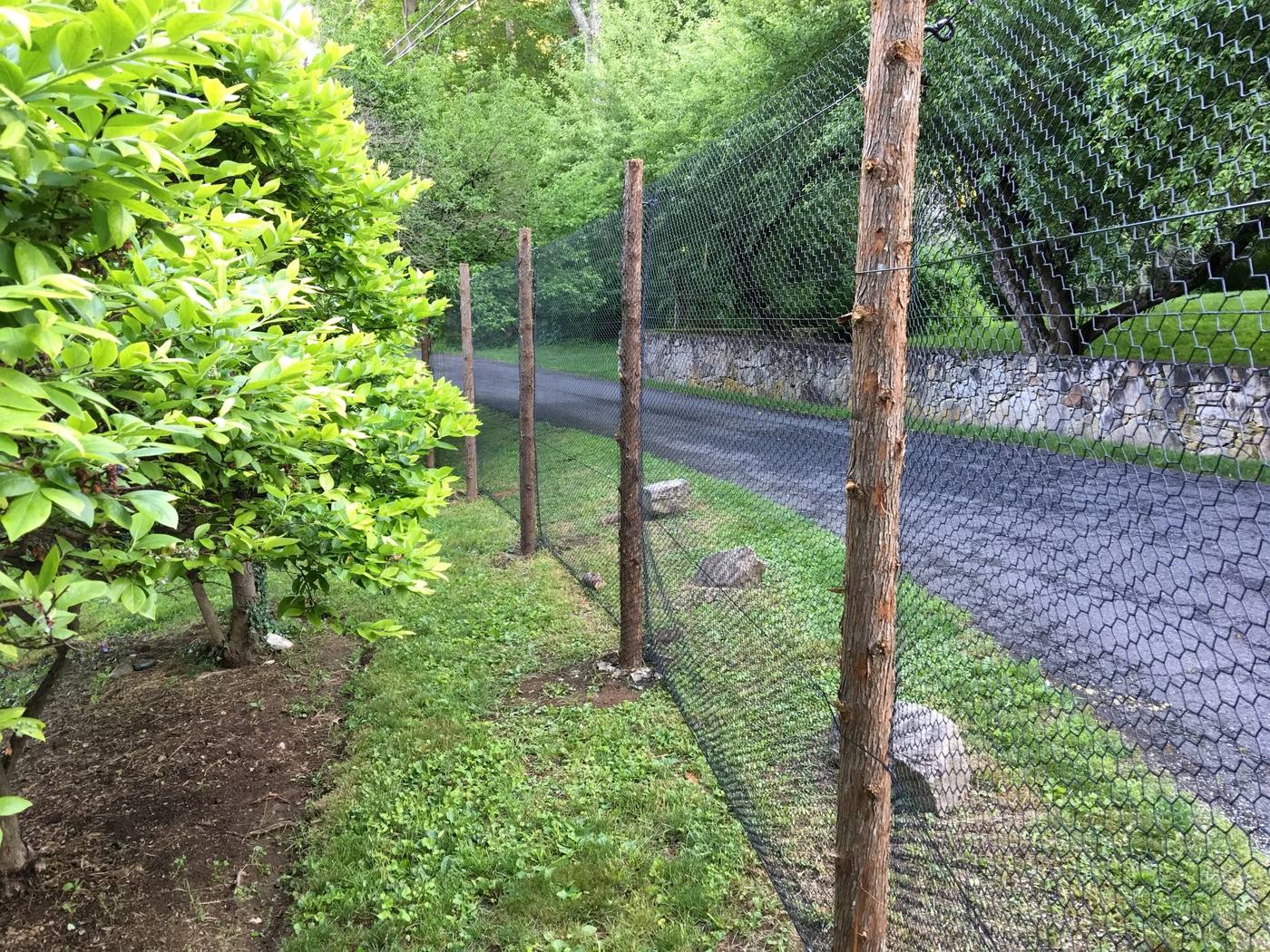
Materials and mesh. You want a barrier deer can’t squeeze through. Practical options include black polypropylene deer mesh (strong, relatively discreet from a distance) and woven or welded wire with openings kept small enough that a deer can’t push through — generally about 6 inches or less, often tighter near the ground. The mesh has to stay taut. Saggy fabric becomes a climb-and-push problem, not a fence.
No gaps at the ground. Deer crawl under more often than people expect. If the bottom floats over dips or uneven grade, you’ve built an invitation. Keep the bottom edge flush with the ground, or secure it so there isn’t a crawl space. Fill low spots. Pin the mesh where it wants to lift. On slopes, follow the grade so you don’t leave triangular openings under the line.
Gates that latch. A perfect fence with a lazy gate is still an open door. Gates should match the fence height, close square, and latch every time. Watch the bottom: a gate that clears the ground by several inches is a common failure point. We use heavier gate posts, hardware that stays true, and an opening wide enough for a wheelbarrow or mower — without a deer-sized gap when it’s closed.
Planning the line: gardens, orchards, and weak points
Start with what you’re protecting.
- Vegetable gardens — enclose the growing area tightly, with working room inside so you’re not tempted to prop the gate open.
- Orchards and young trees — a full enclosure around the planting block beats individual cages that get knocked aside or outgrown.
- Mixed beds — sometimes a shorter run that ties into a building or existing tall fence is enough, as long as the joints stay tight.
Corners and gates fail first. Corners take the tension; gates take daily use. Put gates where you’ll actually use them so the “temporary” propped-open habit never starts. Keep the line simple: fewer jogs mean fewer soft spots. Clear brush, wood piles, or step-ups outside the fence so deer can’t effectively shorten the height.
Bucks County ground: rock, clay, and frost
This matters for any fence here. Much of central and upper Bucks sits on shale and rock just under the lawn. Low spots hold clay and water. Winter freeze-thaw lifts anything set too shallow.
Posts need to go below the frost line and stay plumb. We expect rock and bring the tools for it. Tall mesh puts more tension on posts than a short picket fence — corners and ends get braced properly. On slopes we follow grade so the mesh stays tight to the ground instead of floating. You don’t need an engineering lecture to hire this out. You do need a crew that isn’t surprised by the first shovel of stone.
Permits, neighbors, and HOAs
Rules vary by township and borough across Bucks and eastern Montgomery — height, setbacks, and whether a permit is required depend on your property. We check what your municipality asks for and handle the paperwork when it’s needed. Same for HOA approvals; black mesh often reads quieter from the street than a solid wall, but design review still applies where you have an association.
Before any digging, we submit the PA One Call (811) locate. Talk with neighbors if the line runs near a shared boundary — better sorted before posts go in than after. We’re not citing ordinance numbers here; they change by township. On the estimate walk we deal with your specific lot.
Ready for a fence that holds?
If deer are winning on your garden or young plantings, a short fence won’t turn the tide. Tall fencing — typically 7 to 8 feet — tight to the ground, with mesh deer can’t push through and gates that close and latch, is what we build from Doylestown and New Hope to Newtown, Quakertown, and Horsham.
We’re locally owned: Tim Dunn owns the company; Eric Matsinger is our general manager. We give free on-site estimates with zero dispatch fees. On the walk we’ll look at grade, corners, gate placement, and what you’re protecting, then give you a clear written quote.
- Central & Upper Bucks (Doylestown area): 215-602-4334
- Lower Bucks & eastern Montgomery (Newtown area): 610-477-7080
Call the office closest to you, or book a time for us to walk the line. We’ll tell you straight whether deer fencing is the right fix — and build it so it stays up through Bucks County winters and Bucks County deer.