Racked vs. Stepped Fence Panels: Which Works on Your Sloped Bucks County Yard?
If your yard drops toward a creek, rolls down to a tree line, or climbs a rocky rise, you’ll hit one decision early in planning a fence: should the panels follow the ground, or should they step down the hill like a staircase? That’s the racked vs. stepped fence question, and the right answer depends on your slope, your material, what you need the fence to do, and what you want to look at every day. This guide walks through how we help Bucks County and eastern Montgomery County homeowners make that call before a single post goes in.
For the quick overview of fencing on uneven ground, start with our guide to fencing a sloped yard. This post goes deeper on choosing between the two methods.
Racked vs. stepped: the 30-second version
- Racked (also called contoured): The rails run parallel to the ground, so the whole fence tilts with the slope while the pickets, boards, or posts stay plumb. The bottom follows the grade, and the top line follows it too.
- Stepped: Every section stays level. At each post, the fence drops down (or climbs up) to the next section. The top line looks like a staircase, and each step leaves a triangle-shaped gap under the downhill end of the section.
Neither one is “the right way.” Plenty of good fences in Bucks County use both: racked along a gentle side yard, stepped where the ground gets steep near the back line.
Step one: figure out what kind of slope you really have
Before you pick a method, know two things: how much the ground drops over the fence line, and whether that drop is steady or lumpy.
A simple way to check is a string line:
- Drive a stake at the high end of the fence line and another one panel-length or so downhill.
- Tie a string to the uphill stake at ground level, run it to the downhill stake, and level it with a line level.
- Measure from the string down to the ground at the downhill stake. That’s your drop over that stretch.
- Repeat along the whole run. If the numbers are about the same, you have a steady slope. If they jump around, you have rolling or uneven ground.
Mark the property line, gates, and any swales or wet spots while you’re at it. If you aren’t sure where the line is, our good neighbor fence tips cover surveys and property pins.
When a racked fence makes more sense
Racking usually wins on a gentle, steady grade. The fence flows with the yard, the bottom stays close to the ground for its whole length, and there are no triangular gaps to fill. It’s often the better choice when:
- You have a dog. A small dog can slip through a step gap that looks harmless to you. A racked fence keeps the bottom tight to the grade. Our dog fence page has more on keeping pets in.
- The slope is long and even. A side yard that drops steadily from front to back is the classic racking job.
- You want a natural look. On rolling properties, a fence that follows the land tends to look like it belongs there.
- You’re building with a material that racks well. Wood can be built to the grade on site, and many aluminum styles are made to rack within the manufacturer’s limits (more on materials below).
The trade-off: on a slope, a racked fence’s pickets or boards stay vertical while the rails tilt, so the fence looks slightly angled from some viewpoints. On a lumpy slope, a fence that copies every dip and bump can look wavy. That’s where stepping, or a mix, comes in.
When a stepped fence makes more sense
Stepping is usually the practical choice when the slope is steep, uneven, or the material simply won’t rack. It’s often the better pick when:
- The ground is steep. Every rackable panel has a limit. Past that, the panel has to be stepped.
- You want a crisp, square top line. A stepped privacy fence reads as a series of level sections, which suits more formal houses and newer neighborhoods.
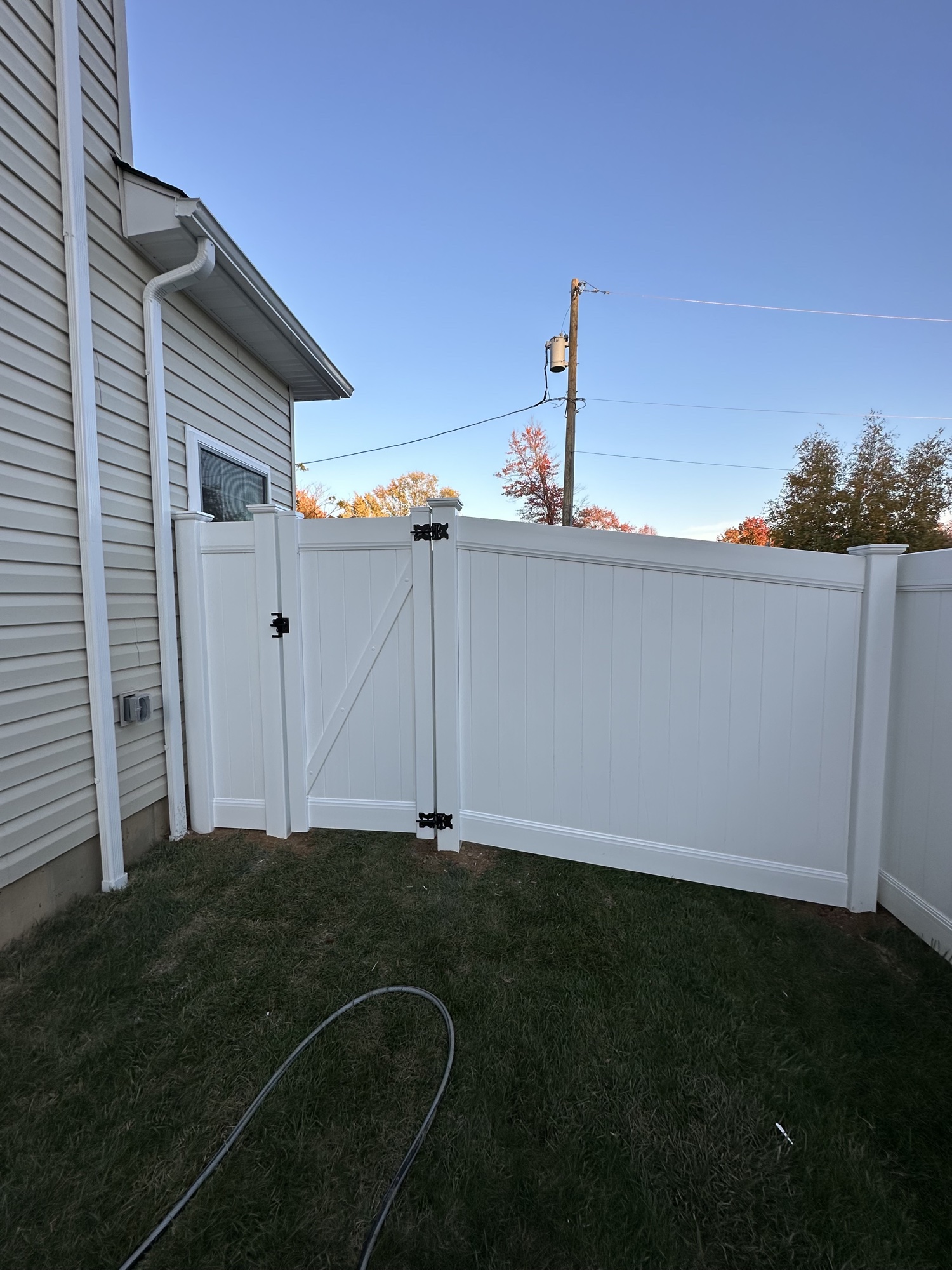
- You’ve chosen vinyl. Most vinyl panels are rigid and are usually stepped. Some styles have a little more give than others, so ask before you commit to a style.
- The grade is rolling. Level sections smooth out small dips and humps instead of copying them.
The trade-off is the gaps. Each step leaves a triangle under the downhill end of the section, and the steeper the slope, the bigger the triangle. Shorter sections mean smaller steps. A trimmed bottom board on a wood fence, a little regrading along the line, or a racked run in the problem spot can close them.
Look at it from both sides, and from the bottom of the hill
Before you choose, walk the line and look at it from where you’ll actually see it:
- From the bottom of the hill, a stepped privacy fence can look like a staircase climbing away from you. Some people like it, and some don’t.
- From the patio or kitchen window, you may see the fence side-on, where a racked top line looks smooth and a stepped one looks blocky.
- From the neighbor’s side, a steep stepped fence can be much taller at the bottom of each step than it looks from your yard. That matters for sight lines and for height rules (see below).
Material by material
Wood privacy and picket fences
Wood is the most flexible option because it’s built on site. Boards can be cut to follow the grade, rails can be set at an angle, and a single fence can rack in one stretch and step in another. That flexibility is a big reason wood fences are popular on hilly lots.
Vinyl
Most vinyl fence panels are stepped on slopes. Plan for the gaps and check the look from below before you lock in a style, especially for a tall privacy panel.
Aluminum and ornamental steel
Many aluminum fence styles come in rackable panels that tilt to follow a slope up to a limit set by the manufacturer. Past that, they’re stepped. Because the pickets are open, step gaps are easy to see, which matters for pets and pools.
Split rail and chain link
Split rail fences naturally follow rolling ground, which is why they look at home on larger properties. Chain link fences follow the grade easily because the fabric flexes.
Height, permits, and slopes
Here’s a detail that catches people: on a slope, “how tall is the fence?” doesn’t have one answer. A stepped section might be 6 feet at the uphill post and noticeably taller at the downhill end, measured from the ground. Townships and boroughs in Bucks and Montgomery County set their own fence height limits, and they don’t all say how height is measured on sloping ground. Before you finalize a design, ask your zoning office how they measure, and design to that.
The same goes for the permit itself. Many towns want a site plan showing fence location and height, and some limit where solid fences can go. Our local permit guides cover the details for specific towns, including Doylestown Township and Newtown Township vs. Newtown Borough. If you’re still deciding how tall to go, read how tall a privacy fence should be.
Water, gates, and pools on a slope
Water: A slope means water is moving somewhere. A solid fence built straight across a drainage path can act like a dam and hold water and debris on the uphill side. Some local codes also say fences can’t divert the natural flow of surface water, so where the fence crosses a swale, leave the bottom open or choose a more open style there.
Gates: A gate that swings downhill can drag before it opens fully. Put gates on the flattest stretch you have and think about swing direction early. A slightly raised gate or a double gate can help on wider openings. See our gates page, and if an older gate is already dragging, read about sagging fence gate repair.
Pools: Step gaps matter most around a pool, where the barrier has to pass inspection. Plan the slope with the pool barrier rules in mind from day one. Our post on pool fence rules in Bucks County explains what inspectors check.
Posts: Whichever method you pick, each post still needs proper depth below the frost line measured from the ground at that post, and on upper Bucks hillsides that often means digging through shale and rock. Call PA One Call before anyone digs; our before you dig guide explains how.
Frequently asked questions
Is a racked or stepped fence better for a dog?
Usually racked, because the bottom follows the ground and doesn’t leave step gaps. If your material has to be stepped, plan to close the gaps with shorter sections, a bottom board, or some regrading.
Can a vinyl privacy fence be racked?
Most vinyl privacy panels are stepped because they’re rigid. Some styles allow a little adjustment, so ask about the specific style before you choose.
Can I mix racked and stepped sections on one fence?
Yes, and it’s common. A fence might rack along a gentle side yard and step down a steeper bank at the back. The goal is a fence that looks intentional from the spots you’ll see it most.
Does a fence on a slope cost more?
Often a bit, because slopes take more layout and labor, and rock adds digging time. Our fence cost page covers what drives price, and an on-site look is the only way to price your hill accurately.
Not sure which way your hill should go?
Every slope is a little different, and the best way to decide is to stand on it together. 76 FENCE BucksMont builds racked, stepped, and mixed fences across Bucks and eastern Montgomery County, and we’ll walk your fence line, check the grade, and show you how each option will look from your yard and your neighbor’s. Request a free on-site estimate through our contact page, or call our Doylestown office at 215-602-4334.