Installing a Fence Near Trees in Bucks County: How to Protect the Roots and the Fence
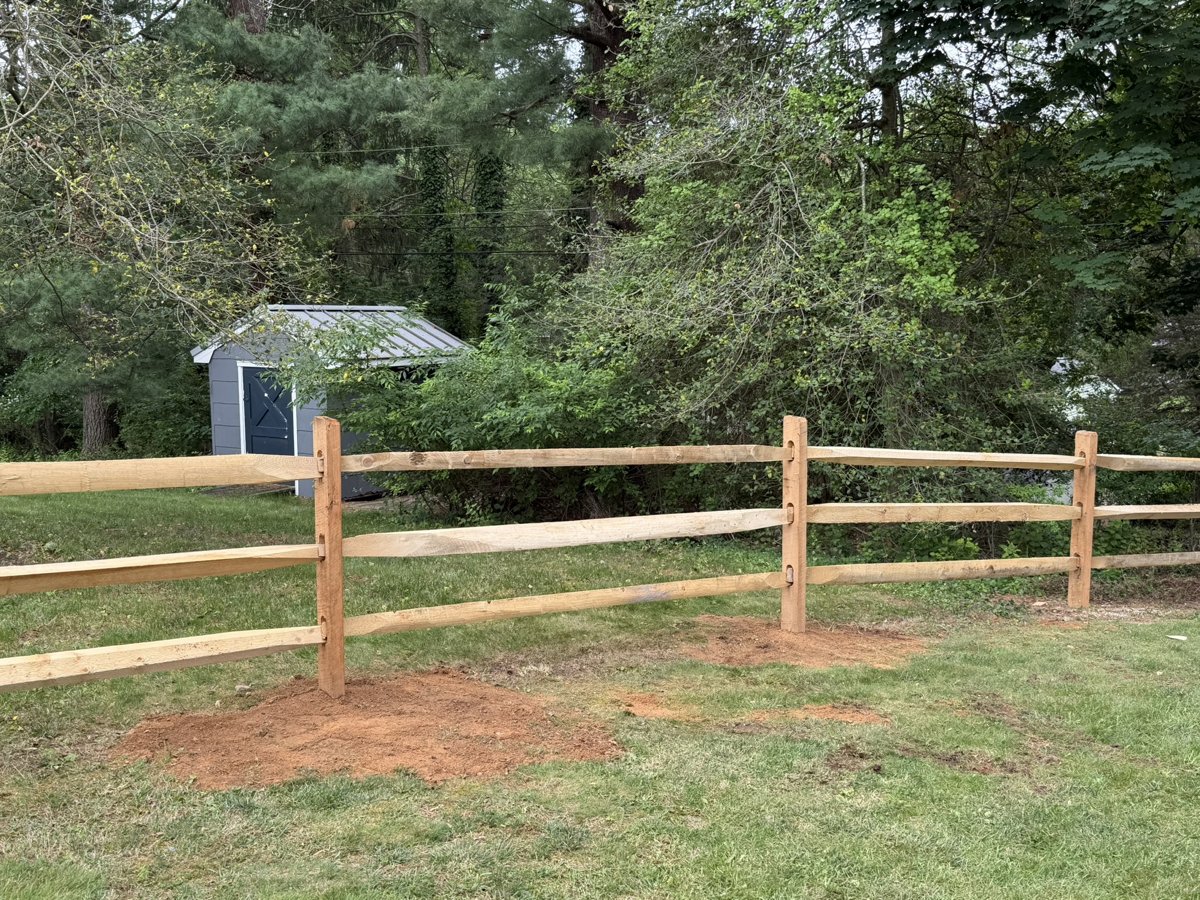
A lot of Bucks County backyards were built around big trees: old oaks on the property line, a row of maples along the back, and a few spruces someone planted forty years ago. They’re a big reason the yard feels the way it does. They’re also the biggest obstacle on a fence line. Dig in the wrong spot and you can damage a tree you’ll be paying to remove in a few years. Set a post too tight and the trunk or roots can push the fence out of line. Here’s how we approach installing a fence near trees so both the fence and the tree hold up.
Why fences and trees fight
Most of a tree’s roots aren’t deep. They spread out sideways in the top foot or two of soil, often well past the edge of the branches. That’s the same zone a fence post hole goes through. So the conflict runs both ways:
- Digging hurts the tree. Cutting through roots, especially big ones, can weaken a tree, open it to decay, or make it less stable in a storm.
- The tree hurts the fence. Trunks and roots keep growing. A post set right against a root or a panel pinned against a trunk will eventually get pushed, lifted, or cracked.
- Branches and debris add up. Limbs that hang over a fence drop on it in ice and wind, and constant shade and leaf litter keep wood fences damp.
Know the tree’s root zone before you plan the line
Arborists talk about a tree’s critical root zone, the area where root damage is most likely to hurt the tree. The International Society of Arboriculture’s rule of thumb, as summarized by its Pacific Northwest chapter, is a radius of 1 foot for every inch of trunk diameter, measured at about chest height (4.5 feet off the ground). Another common rule is the tree’s drip line, the outer edge of its branches. Arborists suggest using whichever is larger.
On a mature tree, that zone can be huge, and on a typical suburban lot you often can’t keep a fence out of it entirely. That’s fine. The point isn’t to avoid the zone at all costs. It’s to dig as little as possible there, dig carefully, and keep post holes away from the biggest roots near the trunk.
How we set posts near trees
- Adjust the post spacing. Most fence styles give us some room to shorten or stretch a section so a post lands between roots instead of on top of one. That’s usually the simplest fix.
- Dig carefully near the trunk. Close to a tree, we dig by hand instead of with an auger, so we can feel roots before we cut them and shift the hole when we hit a big one.
- Leave the big roots alone. The same arborist guidance says never to cut roots more than 4 inches across, because roots that size are usually structural and help hold the tree up. If one sits right where a post needs to go, we move the post.
- Don’t change the grade. Piling soil against a trunk or scraping down around it to level a fence line can hurt the tree as much as cutting roots. On sloped, tree-filled yards, a stepped fence that follows the ground usually beats regrading. Our racked vs. stepped fence guide explains the options.
- Keep the trucks off the roots. Heavy equipment and material piles compact the soil over the roots. We stage materials away from trees when we can.
Never attach a fence to a tree
It’s tempting to use a big trunk as a free post. Don’t. Screws and nails open wounds in the bark, the tree grows around the hardware, and the fence moves every time the tree sways in the wind. In a few years, the panel is twisted and the tree has metal buried in it, which is a hazard for whoever cuts it down someday. Instead, we stop the fence a few inches short of the trunk on each side and set a post there, leaving room for the trunk to keep growing.
Going around a tree vs. leaving a gap
When a tree sits right on the line you want, there are three ways to handle it:
- Leave a gap. End the fence on one side of the trunk and start again on the other. For a property-line fence or a decorative one, this is often the cleanest answer. It won’t work for a dog fence or a pool barrier, where any opening is a problem.
- Jog the fence around the tree. Step the line in or out a few feet so the tree sits fully on one side. Just make sure the new line stays on your property and inside your Township’s setbacks.
- Move the whole line. Sometimes shifting the fence a couple of feet off the property line clears every tree on that side. You give up a strip of yard, but you avoid a lot of root work.
For dog fences, we close gaps at the trunk with a short section or a jog, because dogs find any opening. For pools, the barrier has to be continuous and meet the Uniform Construction Code, so we plan the line around trees from the start. See what your pool fence inspector will check.
Which fence styles work best around trees
- Split rail is the most forgiving. The posts are far apart, the rails can be cut to fit, and it looks at home in a wooded yard. See our split rail fence page.
- Aluminum panels are light, can rack to follow uneven ground, and let air and light through, which helps nearby plantings. See aluminum fences.
- Wood privacy fences can be custom-cut on site, so a section can end exactly where it needs to. Under heavy shade, plan on staining or sealing to fight moisture. See our wood fence staining guide.
- Vinyl comes in fixed panel lengths, so it’s the least flexible around trees. It still works, but it takes more careful layout, and it shows algae and mildew in deep shade if it isn’t washed.
Overhanging limbs, neighbors’ trees, and tree rules
- Look up as well as down. Dead or heavy limbs over the fence line should be dealt with before the fence goes in, not after a winter storm drops them on it. Our post on storm-damaged fences shows what a falling limb can do.
- The neighbor’s tree is the neighbor’s tree. If the trunk is on their side, talk with them before you dig near it. Our good neighbor fence tips can help with that conversation.
- Some towns protect trees. Rules about cutting or damaging trees vary by township and borough, and some are stricter in historic districts, riparian buffers, or new developments. If you’re thinking about removing a tree to make room for a fence, ask your municipality first.
- Get an arborist for valuable or stressed trees. If a tree is old, leaning, or already struggling, a certified arborist can tell you where it’s safe to dig. That’s a small step compared to losing the tree.
And whatever the trees look like, call 811 before any digging. Roots aren’t the only thing under a backyard. See our guide to calling 811 before you dig.
Fence near trees FAQ
How close to a tree can I put a fence post?
It depends on the tree’s size and where its big roots run. Keep posts as far from the trunk as your layout allows, dig by hand near the tree, and move any post that lands on a root more than about 4 inches across.
Can I attach my fence to a tree?
No. It damages the tree, and the tree’s growth and movement will damage the fence. Set a post on each side of the trunk instead.
Will a fence kill my tree?
A fence installed carefully usually won’t. The risk comes from cutting large roots, changing the grade around the trunk, and compacting the soil, which is why we plan the line and the digging around the tree.
What’s the best fence for a wooded lot?
Split rail and aluminum are the easiest to fit around trees. Wood privacy works well with custom cuts. Vinyl takes the most careful layout.
Plan the fence around your trees
76 FENCE BucksMont installs fences on tree-filled lots across Bucks and eastern Montgomery County, from older neighborhoods in Doylestown and Newtown to wooded properties up toward Quakertown and Perkasie. We’ll walk the line with you, mark where posts can go, and lay the fence out so your trees and your fence both last. Schedule a free on-site estimate to get started.