Fencing a New-Construction Home in Bucks County: What to Know First
You just closed on a new home in one of the developments around Warrington, Doylestown, Horsham, or Upper Bucks. The yard is fresh sod or straw over bare dirt, the dog needs somewhere to run, and the house next door is close enough to wave to from the kitchen. A fence is usually near the top of the list. Here’s what 76 FENCE BucksMont tells new-construction homeowners in Bucks County and eastern Montgomery County before the first post goes in.
Start with the paperwork you got at closing
New-construction buyers often have an advantage here: the documents are recent. Your closing packet may include a plot plan or survey showing your lot lines, and in many new subdivisions the surveyor has set property pins at the corners. Find those papers before you do anything else. They show where your line actually runs, which can be different from where the sod ends or where the builder graded.
Look for anything else drawn on the plan, too. Easements for drainage, stormwater, or utilities are common on new lots, and they can limit where a fence can go or how it has to be built. What’s allowed inside an easement depends on the easement and your municipality, so we check that for your address instead of guessing. If the pins can’t be found or the line is unclear, a licensed surveyor can settle it before anyone digs. Our good neighbor fence tips cover why that matters on a shared line.
Your HOA probably has a fence standard
Most newer developments come with a homeowners association, and most associations have something in writing about fences: allowed materials, colors, heights, and where on the lot a fence can sit. Some communities still have the builder running the HOA in the early years, which can affect who reviews your application. Ask your property manager or the builder for the current architectural guidelines before you pick a style.
We help put the application together, with a layout on your plot plan and product details the board can review. HOA approval is separate from the township or borough permit, so you’ll usually need both. Our HOA and community fencing page walks through the approval steps.
New ground behaves differently
Construction moves a lot of dirt. Around a new house you’ll often find fill soil that hasn’t fully settled, compacted areas where equipment parked, and swales the builder shaped to carry rainwater away from the foundation. None of that stops a fence, but it does change how we plan it.
- Posts go below the frost line. In southeast Pennsylvania that’s commonly around 30 to 36 inches, with your local code having the final word. Loose fill makes proper depth and footing even more important.
- Don’t block the drainage. A solid fence run across a swale can act like a dam. We look at where water moves across the yard and plan gaps, gates, or open styles where the water needs to get through.
- Think about grade. New lots in hilly parts of Bucks County often slope toward the back or toward a basin. Our sloped yard guide explains racked versus stepped panels.
- Ask your builder about final grading. If grading, landscaping, or driveway work isn’t finished, it usually makes sense to let that wrap up before the fence goes in so nothing gets torn up twice.
Tell us about everything that’s buried
Pennsylvania requires a PA One Call (811) request at least three business days before digging, and we submit it for every job. On a new lot, that’s especially important because utility lines were just run. Keep in mind that 811 marks generally cover public utility lines. Private lines like irrigation, landscape lighting, a line to a shed, or an invisible dog fence may not be marked, so point those out. If the builder or landscaper gave you an irrigation map, send it along. Our 811 guide has more.
Popular fences for new-construction yards
New developments usually mean smaller lots and closer neighbors, so most of the requests we get fall into a few groups. Your HOA standard will narrow it further.
- Vinyl privacy or semi-privacy. Common in HOA guidelines because it stays uniform and doesn’t need painting. See vinyl fences and semi-privacy fences.
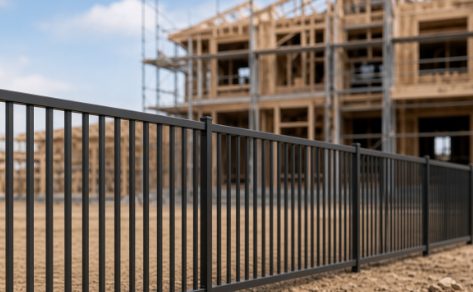
- Black aluminum. Often the go-to for lots that back up to open space or a basin, and around pools. See aluminum fences.
- Dog-friendly layouts. If the main job is keeping a pet in, height, gaps at the bottom, and gate latches matter more than style. Our dog fence page covers what to look for.
Planning a pool down the road? It’s worth saying so up front. Pool barriers have their own requirements under Pennsylvania’s Uniform Construction Code, and it’s easier to plan the fence line and gates once than to rework them later. Our pool fence page explains more.
Talk to the neighbors while everyone’s new
In a new neighborhood, everyone is usually thinking about fences at the same time. If the house behind you is planning one too, a quick conversation can save you from two fences a foot apart with a strip of weeds between them. It’s also worth looking at fences your HOA has already approved on your street. Boards tend to approve a design they’ve said yes to before.
Get your new yard fenced the right way
We handle the township or borough permit, help with the HOA application, and submit the 811 request as part of the job. Schedule a free on-site estimate, and we’ll walk the lot with you, check the plot plan and drainage, and recommend a fence that fits your HOA’s rules. Call 215-602-4334 for central and upper Bucks County, or 610-477-7080 for lower Bucks and eastern Montgomery County.