
Why Your Fence Gate Sags (and How to Fix It) in Bucks County
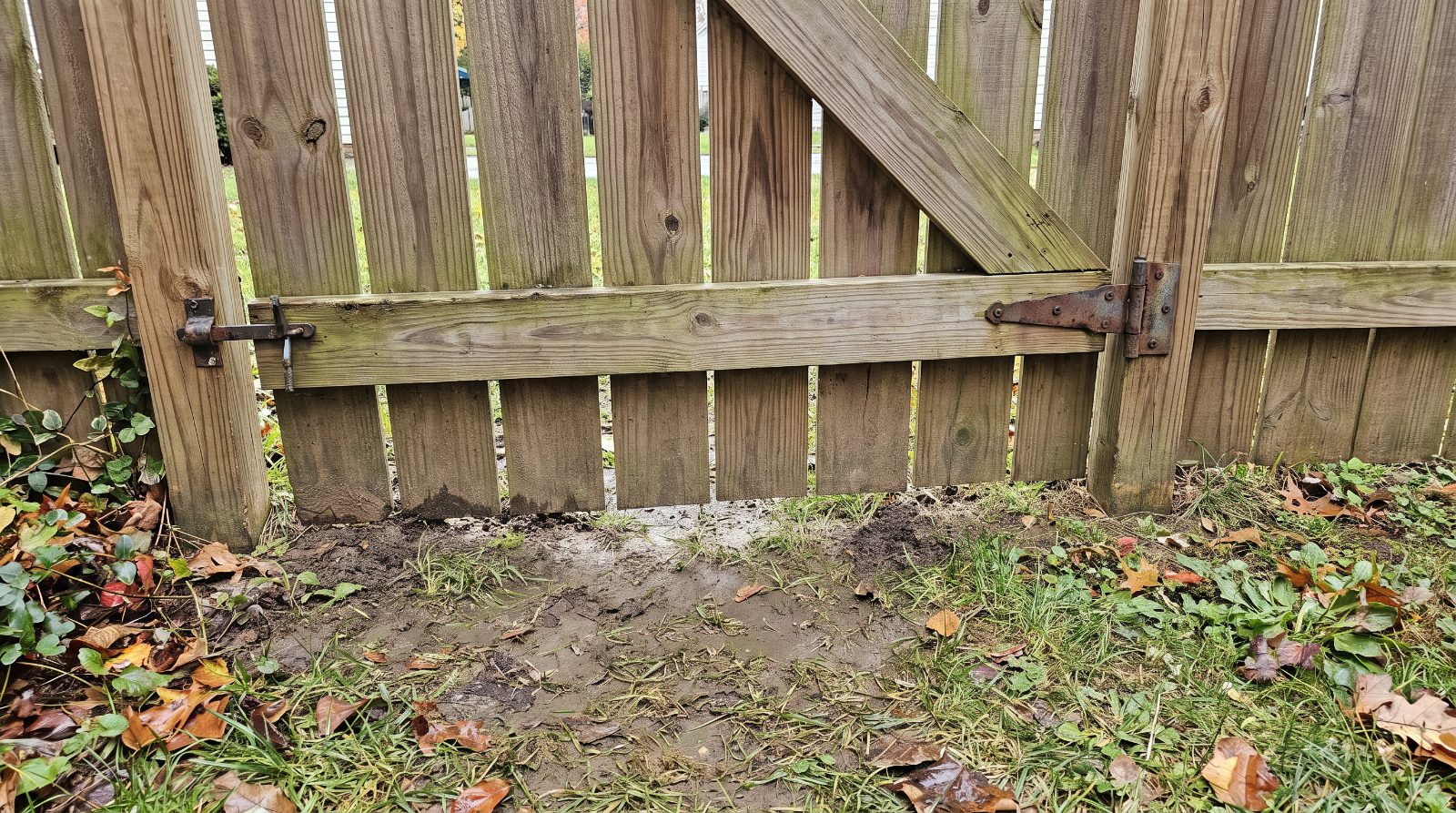
It starts small. The latch needs a little lift to catch. Then the bottom corner scrapes the patio, and pretty soon you’re dragging the gate open with your shoulder. The good news: a sagging gate is often fixable without replacing the whole fence. This guide covers sagging fence gate repair: why gates sag, how to find the real cause, and when it’s a quick fix versus a post reset or a new gate.
Why fence gates sag
A gate hangs off one side and swings all day. When the hinge post, the hinges, or the frame gives a little, the latch side drops. The usual suspects:
- The hinge post is moving. This is the big one. If the post leans even slightly toward the gate, the latch end drops a lot more at the far edge. Posts loosen when they’re set too shallow, set in wet soil, or get pushed up by frost.
- The hinge post is too small for the gate. A post that’s fine for a fence panel can be undersized for a wide or heavy gate. It flexes, then bends, then leans.
- No brace, or the wrong brace. Wood gates need a diagonal brace or a cable to keep the frame square. Without one, the frame racks into a parallelogram over time.
- Hinges and hardware. Light-duty hinges, short screws, screws stripped out of soft or weathered wood, or hinges set into end grain will loosen and let the gate droop.
- Wood movement. Wood gates swell in our humid summers and wet springs, then shrink in winter. A gate hung tight in a dry month can bind or rub once it swells, and that extra stress loosens fasteners.
Five-minute DIY checks to find the cause
Before you buy parts, figure out which piece is actually failing. You’ll need a level and a few minutes.
- Check the hinge post for plumb. Hold a level on the side of the post. If it leans toward the opening, the post is your problem, not the gate.
- Push the post. Grab the top of the hinge post and push it back and forth. Any rocking or movement at ground level means it’s loose in the ground.
- Lift the latch end. Lift the gate’s free corner until it lines up with the latch. If it lines up easily and the post doesn’t move, the sag is in the hinges or the frame.
- Check the hinges. Look for gaps between the hinge leaf and the post, screws that spin without tightening, or bent hinge straps.
- Check the frame for square. Measure corner to corner both ways on the gate frame. If the two diagonals aren’t close, the frame has racked.
Also check the latch post. If it has shifted, the gate may be hanging fine but missing a target that moved.
Fixes you can usually make at the gate
If the post is solid and plumb, the repair usually happens at the gate itself:
- Re-fasten the hinges. Swap stripped screws for longer exterior-rated screws that bite into fresh wood, or through-bolt the hinges where the design allows. Galvanized or stainless hardware holds up better outdoors.
- Upgrade the hinges. Heavy strap hinges or adjustable gate hinges carry more weight and let you fine-tune alignment later.
- Add or correct the brace. On a wood gate, a rigid diagonal brace should run from the bottom corner on the hinge side up to the top corner on the latch side. Installed the other way, it does very little.
- Install an anti-sag cable kit. A cable with a turnbuckle runs the opposite direction from a rigid brace: from the top hinge-side corner down to the bottom latch-side corner. Tighten it gradually to lift the latch end back into square.
- Give it clearance. If a swollen wood gate rubs the post or ground, trimming it to leave a little room for seasonal movement keeps it from binding again. Keeping the wood sealed helps too. Our staining and sealing guide covers that.
When the post has to be reset or replaced
No cable kit or new hinge will save a gate hanging on a moving post. If the hinge post leans, rocks, or has risen out of the ground, the post needs to be reset deeper or replaced, often with a heavier post.
Here in southeast Pennsylvania, frost depth is commonly around 30 to 36 inches, and gate posts should be set at least that deep and solid because they carry a swinging load. Clay that holds water, low spots by downspouts, and rocky central and upper Bucks ground where a hole stopped short are all common reasons gate posts move. If your gate sags every spring and recovers a bit by summer, frost is a likely culprit. Our guide to leaning fence posts and frost heave explains how to fix that for good.
Replace rather than reset when a wood post is soft or rotted at the ground line, when the post is undersized for the gate, or when you’re widening the opening. Resetting or replacing a post means digging, so a PA One Call (811) request has to go in first. See our before you dig guide.
Wood vs. vinyl vs. aluminum gates
Different materials sag for different reasons:
- Wood gates are the most likely to sag in the frame itself. They’re heavy, they move with the weather, and they depend on bracing and good fasteners. They’re also the easiest to adjust or rebuild.
- Vinyl gates usually get their strength from an internal metal frame or reinforcement, and the hinge post is often reinforced too. When a vinyl gate droops, check whether the hinge post was reinforced and set solidly, and whether the hinge brackets have loosened. Cracked rails or a bowed frame usually mean the gate needs replacing, not adjusting. Our vinyl vs. wood comparison covers the trade-offs.
- Aluminum gates are lighter and usually have welded frames that hold their shape well. When they sag, it’s usually a post or hinge issue, and many use adjustable hinges that can be tuned back into line.
Wide driveway gates and double gates need extra attention whatever the material. A drop rod or cane bolt that holds the inactive leaf in place takes strain off the hinges. For a single wide opening, a double gate is often the better choice than one long leaf. Our gates page shows the options.
Pool gates can’t wait
If the sagging gate is part of a pool barrier, fix it right away. A gate that drops even a little can stop self-closing and self-latching, which is exactly what a pool barrier depends on. Our pool fence rules guide explains what inspectors look for. Requirements can vary by township, so check with yours if you’re changing the gate or hardware.
Repair, reset, or replace: a quick guide
- Repair the gate if the post is plumb and solid and the problem is hinges, screws, bracing, or a slightly racked frame.
- Reset or replace the post if the hinge post leans, rocks, heaves, or is rotted, even if the gate itself is fine.
- Replace the gate if the frame is rotted, cracked, or badly bent, or if you’re changing width or style anyway.
If several posts along the fence are leaning or a storm did the damage, look at the whole line. Our storm damage repair vs. replace guide can help you decide.
Get your gate swinging right again
76 FENCE BucksMont handles fence and gate repairs across Bucks County, eastern Montgomery County, and our northern service area. We’ll check the posts, hardware, and frame and tell you plainly whether it needs an adjustment, a post reset, or a new gate. Request a free on-site estimate through our contact page, or call 215-602-4334 for central and upper Bucks (Doylestown area) or 610-477-7080 for lower Bucks and eastern Montgomery (Newtown area).